About CEADS
The Common European Agricultural Data Space connects Europe's agricultural data ecosystems so information is collected once and reused, with the right permissions, across organisations and borders.
Mission
Reduce the administrative burden in European agriculture by making trusted information reusable across organisational and national boundaries: collected once, reused for reporting, sustainability assessment, certification, advisory services and research, with the rights of farmers and other data holders respected in every interaction.
Vision
A connected digital agricultural ecosystem in which existing data-sharing initiatives interoperate through common rules, open standards and reusable interaction profiles, and in which trusted, well-described data form the foundation for better decisions, new services and AI-supported applications, from the farm to European policy.
Principles and values
- Federation, not centralisation. Participants keep their internal governance and operational autonomy.
- Data sovereignty. The party holding rights to the data decides who may use them, for which purpose and under which conditions.
- Farmers as entrepreneurs and rights holders. Consent, mandate, representation and benefit are part of every interaction, also when a DSI or service provider acts on a farmer's behalf.
- Open standards and pragmatic reuse. European building blocks are adopted where they fit a federated agricultural ecosystem, and complemented where they do not.
- Responsible behaviour. The CEADS Code of Conduct sets ten principles for responsible data sharing, building on the EU code of conduct on agricultural data sharing by contractual agreement.
- Evidence over promises. Eight real-life use cases and an open call test what works before it is scaled.
The CEADS ecosystem
- Partners
- 36
- EU countries
- 15
- Data-sharing initiatives
- 18
- Open calls
- 1+
Partners
36 partners from 15 EU countries, coordinated by ILVO. The open call adds 17 more organisations.
Project coordinator
Academic and research institutes
-
 Wageningen University & Research, Netherlands
-
 Josephinum Research, Austria
-
 Fondazione Bruno Kessler, Italy
-
 INRAE, France
-
 Luxembourg Institute of Science and Technology, Luxembourg
-
 Université Paris Dauphine-PSL, France
-
 Universitat de Lleida, Spain
-
 Poznań Supercomputing and Networking Center, Poland
-
 Natural Resources Institute Finland (Luke), Finland
-
 Fundación CTIC, Spain
-
 RISE Research Institutes of Sweden, Sweden
-
 University of Osnabrück, Germany
Data and technology experts
-
 Netcompany-Intrasoft, Luxembourg
-
 VDI/VDE Innovation + Technik, Germany
-
 Data Space Europe, Finland
-
 Synelixis, Greece
-
 iSHARE Foundation, Netherlands
-
 AnySolution, Spain
-
 DEDA Next, Italy
-
 GS1 in Europe, Belgium
-
 Orange Business, France
-
 ZuchtData (Rinderzucht Austria), Austria
Agricultural and food sector specialists
Industry associations and networks
-
 CEMA, European Agricultural Machinery Industry Association, Belgium
-
 Agricultural Industry Electronics Foundation (AEF), Germany
-
 FNSEA, France
-
 Anamob-DIH, Romania
-
 WalDigiFarm (associated partner), Belgium
Data-sharing initiatives

Public sector and policy organisations
-
 Teagasc, Ireland
-
 CREA, Council for Agricultural Research and Economics, Italy
-
 Jordbruksverket, Swedish Board of Agriculture, Sweden
-
 Ruokavirasto, Finnish Food Authority, Finland
Data-sharing initiatives
CEADS connects existing data-sharing initiatives: platforms and ecosystems through which farmers, companies, cooperatives and authorities already share data, such as DjustConnect, Agrirouter, Agronod, eDWIN, the CDAF data space and many others. See all initiatives or connect your own ecosystem.
Stakeholders
CEADS works for six groups, each with its own page: farmers and farmer organisations, data-sharing initiatives, digital solutions and service providers, agri-food businesses and data holders, researchers and advisory services and public authorities and policy makers.
Related initiatives and networks
- Other European data spaces: the Data Spaces Support Centre and the sectoral data spaces for health, mobility, energy, tourism and manufacturing. CEADS aligns with the DSSC blueprint and the Commission's SIMPL middleware.
- Green Deal Data Space (SAGE): CEADS works with SAGE on technical interoperability, governance, business alignment and cross-data-space use cases. Linking agricultural and environmental information can support sustainability assessments, carbon accounting and evidence for carbon-credit schemes, subject to applicable methodologies and independent verification.
- Projects: AgriDataSpace (2022-2024), which prepared the roadmap for CEADS; AgrifoodTEF, the Agriculture of Data partnership and EOSC for research data; and the use case projects of the consortium partners.
- Standards and communities: GS1, ICAR and iDDEN for livestock data, AEF for machinery data, the DjustConnect and Agrirouter communities and the national agricultural data initiatives.
The CEADS EU project
Background
CEADS is co-funded by the Digital Europe Programme (grant agreement 101195295) and runs from April 2025 to March 2028, coordinated by ILVO with 36 partners from 15 EU countries. It builds on the AgriDataSpace preparatory action, on earlier work on agricultural data spaces in Europe and on the EU code of conduct on agricultural data sharing. CEADS is turning from a funded project into a lasting European organisation.
Timeline
CEADS has moved beyond conceptual design and has demonstrated its first data exchanges, but it is not yet a fully operational European federation. It will be by the end of March 2028.
| When | Milestone |
|---|---|
| By September 2025 | Initial design and preparation. Use-case methodology established and concrete data-sharing scenarios defined across eight use cases in the Use Case Implementation Plan. |
| 2025 | MVP1: first working deployment. Reference Architecture developed and MVP1 delivered as a working deployment of the architectural baseline. First completed scenario: crop-protection registration data from a farmer to a KPI-managing authority. |
| 2026 | From individual exchanges to reusable interaction patterns. Technical components, governance, onboarding, identity and trust arrangements developed and tested with the use cases and DSIs. Reference Architecture version 0.5. In September 2026 the Executive Board adopted the role model and interaction-profile approach as the basis for MVP2. The open call brings 17 additional partners into CEADS. |
| Beginning of 2027 | MVP2 and broader validation. MVP2 implemented while additional DSIs and use-case partners are onboarded. Focus on making information reusable for authorised agricultural purposes, not only on transferring data. |
| Towards March 2028 | Operationalisation and scaling. Transition from pilots to operational services, sustainable governance, repeatable onboarding and a longer-term operating model. Work on discoverability, semantics and controlled access lays the foundation for AI-driven agricultural services. |
Open call
An open call extends participation beyond the original consortium: 17 additional partners join CEADS to test the applicability and reuse of its approach in new organisational contexts. Interested in a future call? Get involved.
Funding
CEADS is co-funded by the European Union under the Digital Europe Programme. Views and opinions expressed are those of the authors only and do not necessarily reflect those of the European Union or the granting authority.
Results and deliverables
Public deliverables, presentations and newsletters are published under Resources and in News & events.
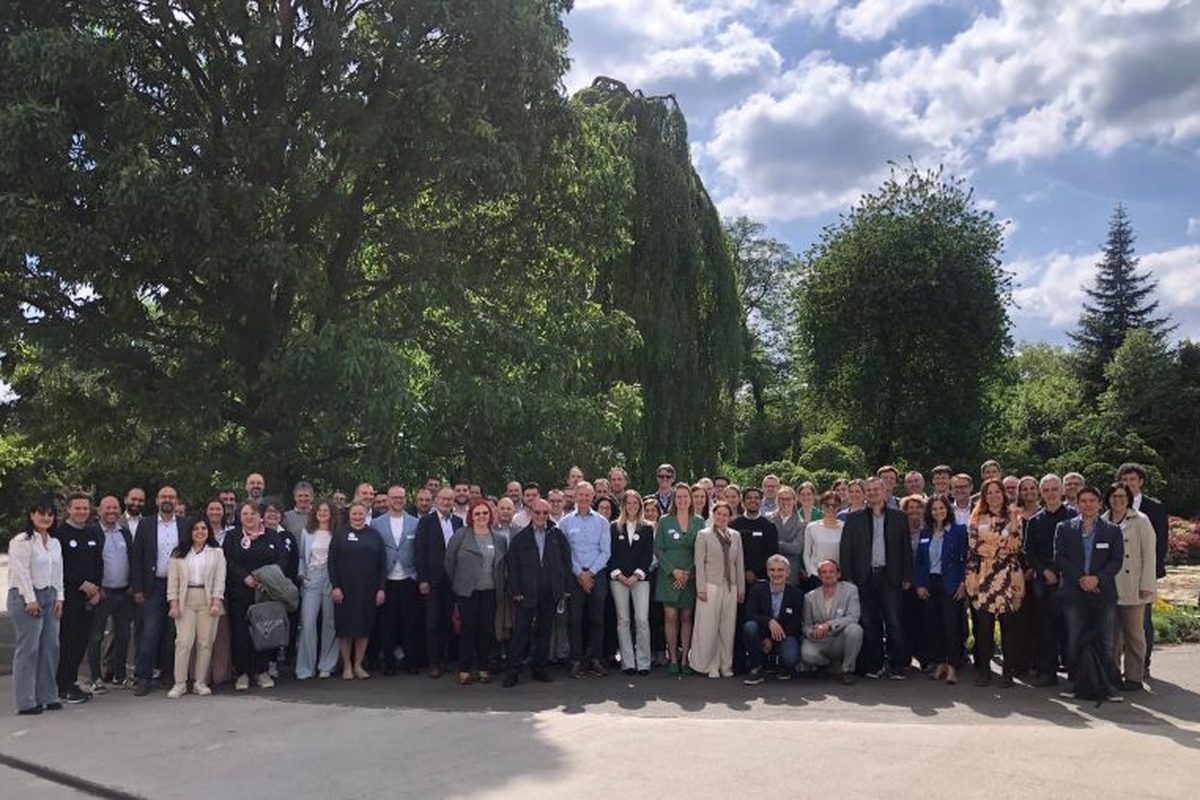
Consortium kick-off, April 2025 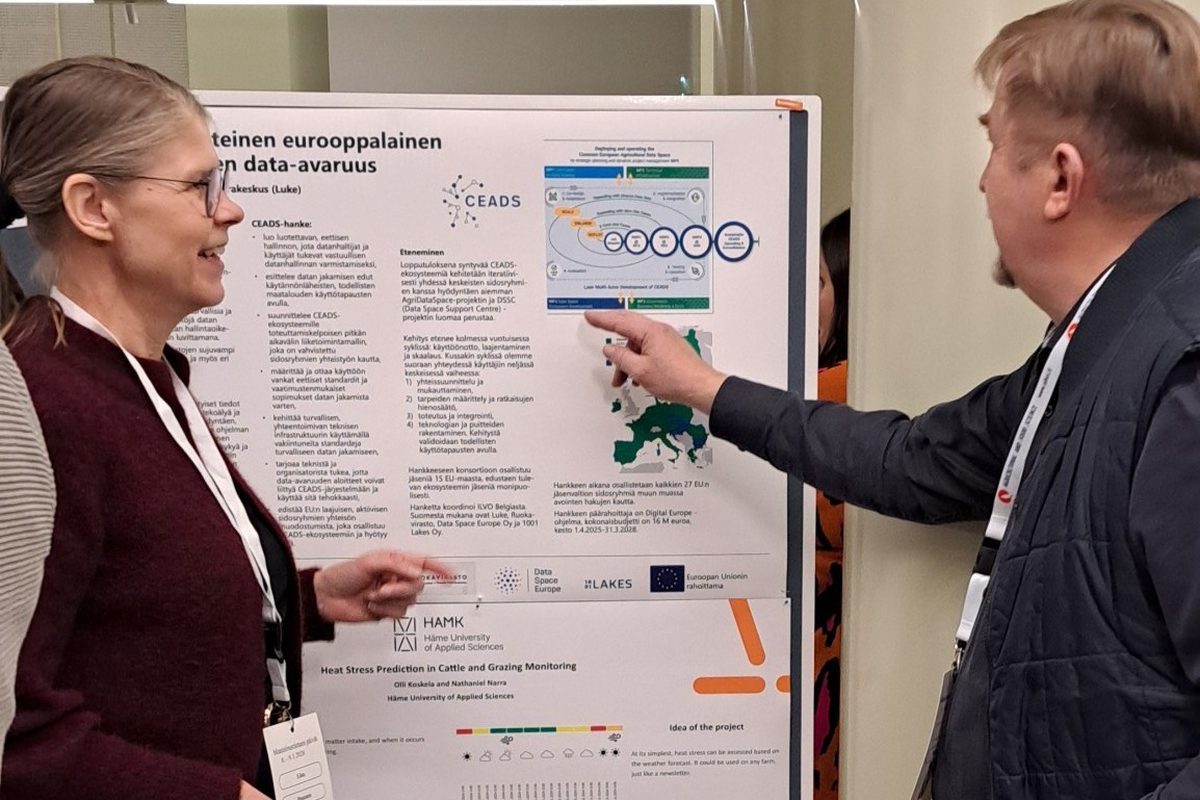
CEADS poster at the Agricultural Science Days, Helsinki 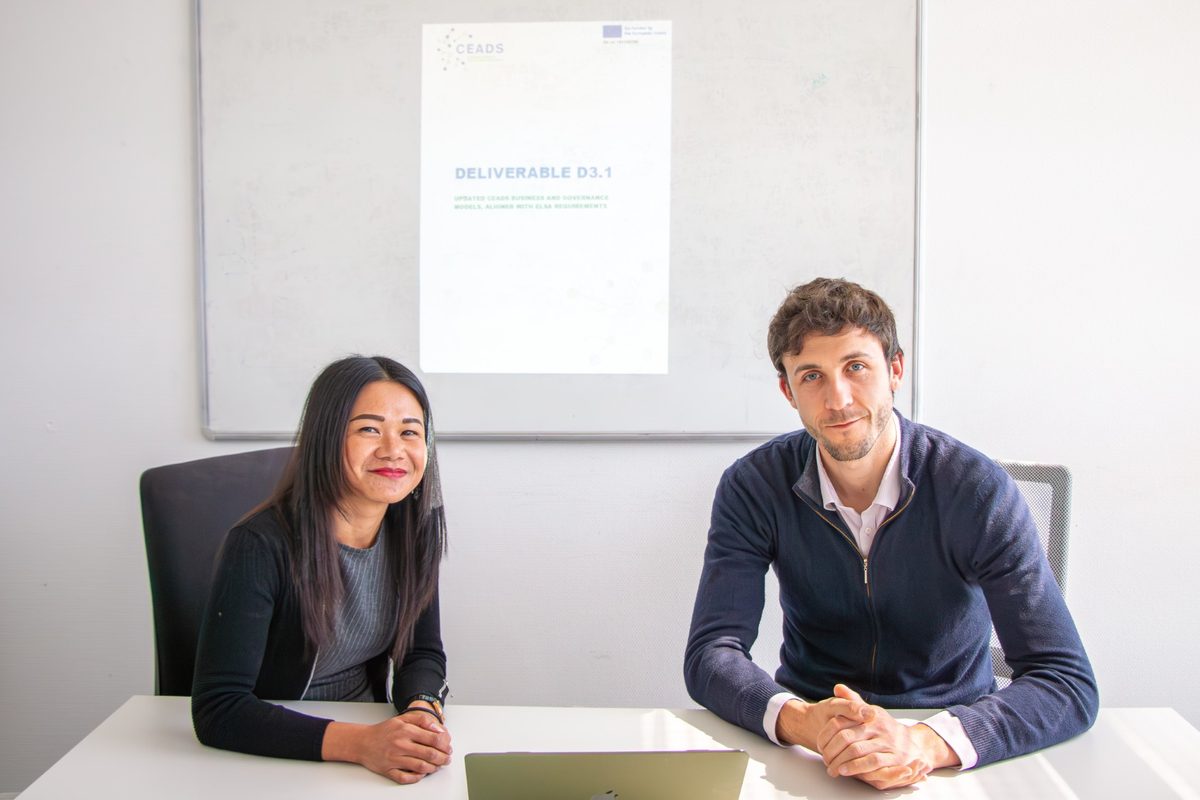
Team Dauphine working on the first deliverables 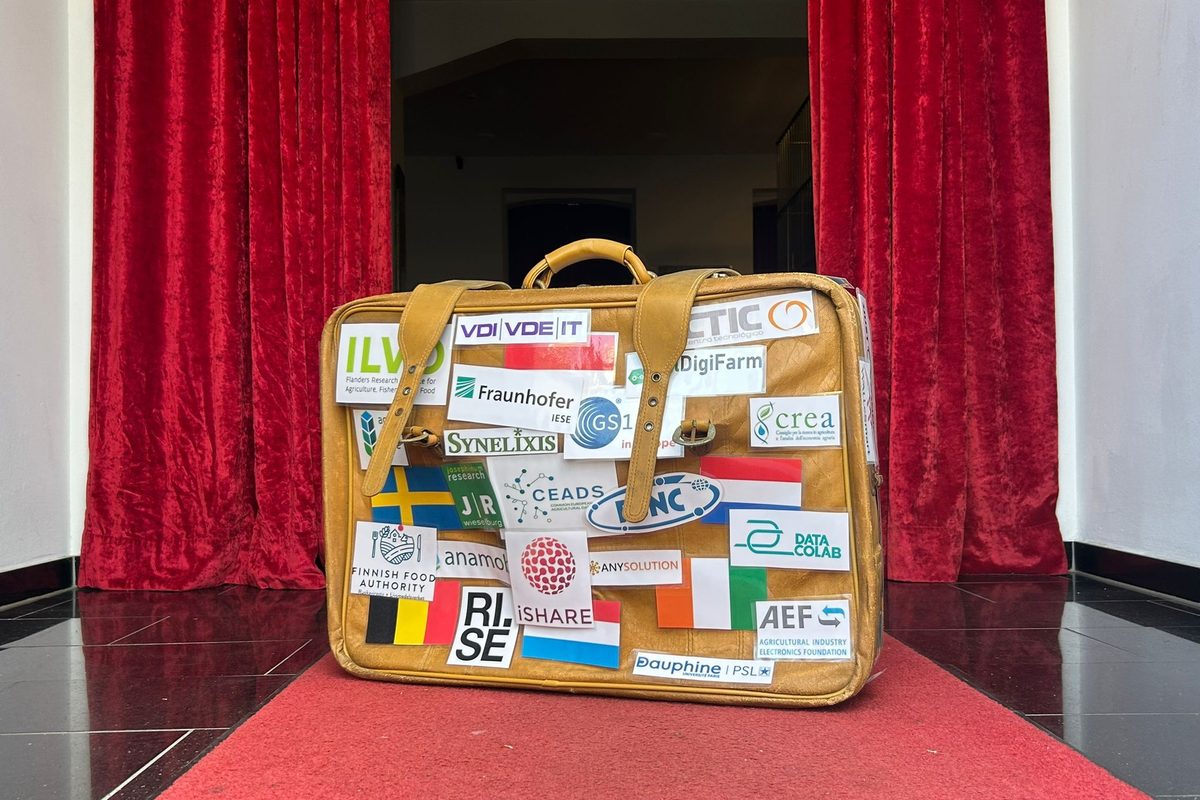
The CEADS suitcase, one sticker per partner
Governance
CEADS is governed as a federation: common arrangements at European level, autonomy for the participating data-sharing initiatives and organisations.
- Common Vision: the strategic direction shared by all partners.
- Code of Conduct: ten principles for responsible behaviour in the data space.
- Rulebook: translates vision and principles into participation, technical, service, contractual and operating arrangements. The Rulebook and the permanent governance structure are still being refined and validated with the use cases.
- Executive Board: steers the project and adopts the working basis for each development stage, such as the role model and interaction-profile approach adopted in September 2026.
- Coordinator: ILVO coordinates the consortium and runs the helpdesk and onboarding.
- Towards a lasting organisation: by March 2028 CEADS moves from a funded project to a sustainable operating model with repeatable participant onboarding.
Governance and business development inform one another: governance should enable viable services and protect participants' rights, while practical needs and use case experience refine proportionate arrangements.
Contact
CEADS coordination
ILVO, Flanders Research Institute for Agriculture, Fisheries and Food
Burgemeester Van Gansberghelaan 92, 9820 Merelbeke-Melle, Belgium
ceads@ilvo.vlaanderen.be